
Container Securing - Understanding Container Lashing Systems: What Every Surveyor Needs to Know
Lashing components, common failure modes, and the forces that put container stacks at risk
CONTAINERS
5/19/20264 min read
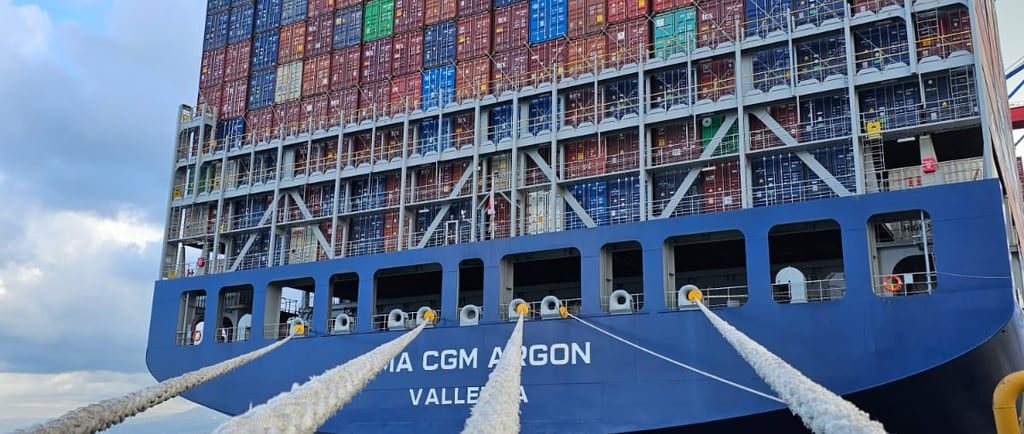
Blog Post 1 — Marine Surveying
Understanding Container Lashing Systems: What Every Surveyor Needs to Know
A deep dive into lashing components, common failure modes, and the forces that put container stacks at risk
Introduction
Container shipping transformed global trade by standardising cargo into manageable, stackable units. Yet despite decades of development, container loss at sea remains a persistent and costly problem — one that places marine surveyors at the centre of a critical chain of safety. Whether you are conducting a pre-loading inspection, a damage survey following heavy weather, or a post-incident investigation, a thorough understanding of lashing systems and their failure modes is indispensable.
This article provides a practical reference on how container lashing systems work, what causes them to fail, and what surveyors should look for in the field.
1. How Modern Container Ships Have Changed the Stakes
In the early days of containerisation, ships carried three or four tiers of containers on hatch covers, secured by a combination of stacking cones, twistlocks, lashing rods, and turnbuckles. These methods proved effective at those modest stack heights. Today, a new-Panamax vessel can carry containers stacked twelve tiers high on deck — yet the fundamental lashing technology has barely evolved. Turnbuckles and lashing bars still physically reach only to the bottom of the third tier container, or slightly higher where a lashing bridge is fitted.
This mismatch between ship capability and securing technology means that the forces acting in the upper portions of a tall stack are not always fully understood by those responsible for the vessel. For the marine surveyor, recognising this gap is the starting point for any meaningful assessment.
2. The Six Degrees of Ship Motion and Their Impact on Lashings
A vessel at sea experiences six degrees of motion: surge, sway, heave, roll, pitch, and yaw. Additionally, the hull itself bends and twists as waves pass beneath it, causing hatch covers to move relative to hatch openings and container stacks to flex as clearances in lashing equipment are taken up. The lashing system alone resists all of these movements.
Critically, the forces generated by ship motion are not static — they are dynamic and accelerative, increasing and decreasing as the vessel moves. Rolling is the dominant contributor to lashing loads, but it must always be considered in combination with pitching and heaving to determine the worst-case loading scenario. During surveys following a loss incident, surveyors should request the vessel's motion data and weather records to reconstruct the force environment that the lashings experienced.
3. Lashing Components: Fixed and Loose Fittings
Fixed Fittings
Fixed fittings are permanently attached to the ship and include flush sockets, raised sockets, lashing plates (pad-eyes), D rings, and dovetail foundations. These are assessed during classification and must be maintained as part of the ship's planned maintenance programme. Surveyors should pay particular attention to:
• D ring welds — poor weld penetration is a known cause of catastrophic lashing failure. Visual inspection during routine maintenance can identify this risk before it becomes a loss event.
• Dovetail foundations — these are subject to wear and can allow base twistlocks to be pulled free under extreme dynamic loads. They must form part of the ship's planned maintenance schedule with regular examination and testing.
• Pad-eyes — designed for in-plane loading only. Out-of-plane loads can bend the plate and crack the weld.
Loose Fittings
Loose fittings — twistlocks, lashing rods, turnbuckles, stacking cones, semi-automatic twistlocks (SATs), and fully automatic twistlocks (FATs) — are portable and not typically surveyed by the classification society during regular ship surveys. Each must carry a valid test certificate and be approved and listed in the ship's Cargo Securing Manual (CSM). During a survey, check for:
• Mixing of left-hand and right-hand twistlocks in the same stow — this makes it nearly impossible to confirm locked status visually.
• Corrosion, distortion, or wear on lashing rods and turnbuckle threads.
• Use of uncertified or improvised equipment, which must always be rejected.
• Correct application of FATs in accordance with manufacturer's instructions — certain FAT designs activated by slewing the container on its vertical axis have been linked to container losses overboard.
4. Common False Beliefs That Lead to Failures
Marine loss investigations consistently reveal that container losses often result from misconceptions about lashing behaviour. Key false beliefs include:
• 'A lashed stow is a static block' — Twistlock and socket clearances allow containers to move before the twistlock fully engages. Wear inside corner fittings adds further movement.
• 'Lashing rods should be as tight as possible' — Overtightening causes additional strain on the rods and can lead to corner casting failure under load. Rods should be firm but not overtightened.
• 'Lashings do not need adjustment at sea' — Temperature changes and container movement cause tension to vary. Rods should be checked within 24 hours of departure and regularly throughout the voyage.
• 'All twistlocks have the same strength rating' — Twistlocks are rated for different tensile loads, typically 20 or 25 tonnes. Mixing ratings in the same stow is dangerous.
• 'Heavy containers can be placed anywhere in the stack' — Stack weight distribution directly affects internal lashing forces. Placing heavy containers high or above light containers can exceed the design assumptions of the securing arrangement.
5. Surveyor Action Points
When conducting any survey involving container lashing systems, the following checks should be considered as a baseline:
• Verify that the Cargo Securing Manual is on board, current, and is actually being followed by the officer in charge of cargo operations.
• Check that lashing software output and warning messages have been reviewed before loading.
• Inspect corner castings and corner posts of containers for damage or buckling — a damaged bottom container will likely cause entire stack collapse.
• Confirm that all loose lashing equipment has valid test certificates and is listed in the CSM.
• Examine dovetail foundations, D rings, and pad-eyes for wear, corrosion, and weld integrity.
• Verify that turnbuckle locking nuts are fully tightened and that no left-hand and right-hand twistlocks are mixed in the same stow.
• Where bad weather has been encountered, check for evidence of container movement, lashing slackening, or damage to fixed fittings.
Conclusion
Container lashing is deceptively complex. Ships are larger, loads are higher, and the consequences of failure — containers lost overboard, hazardous cargo in the water, navigation hazards — are significant. For the marine surveyor, mastery of lashing systems is not merely useful: it is a professional requirement. Understanding the forces involved, the known failure modes, and the critical importance of correct equipment and procedure is what separates an effective survey from a box-ticking exercise.
Office hours:
info@apexmarinesurveys.com
+9613820253
24/7 contact:
Capt. Ihab Shaaban
Mon-Fri - 09:00 - 17:00
Excellence in Every Survey
Apex Marine Surveys SARL




+9611411445